capnwasm render bench
End-to-end pipeline: request → wire → decode → field reads →
DOM mutation → forced layout. capnweb × capnwasm crossed with WebSocket × HTTP-batch,
each at three sizes, with cold & warm timings. No averages between transports — you see every cell.
Not production-ready yet. This benchmark explores the tradeoff boundary, not
a hardened deployment claim. Normal readers now use managed WebAssembly.Memory, while
allocator, large-data, hostile-input, and secure-memory hardening continues.
Summary
How to read this page
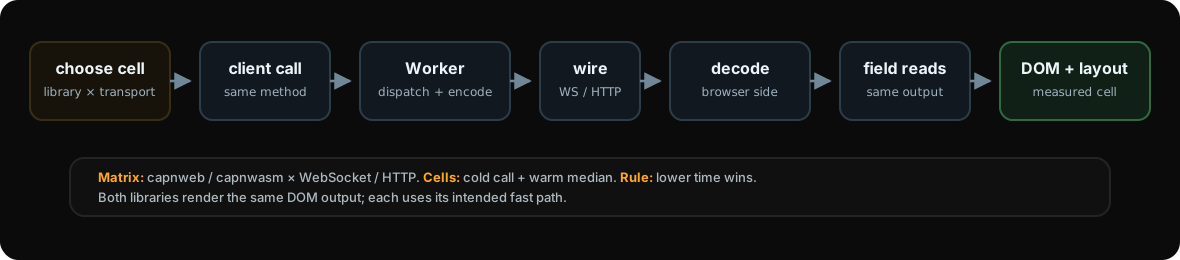
Every cell measures the full path above. The matrix crosses capnweb/capnwasm with WebSocket/HTTP; lower cold and warm timings win. Both libraries are allowed to use their intended fast path, and each workload renders the same DOM output.
Workload 1 — List render
Server returns N user records in one RPC reply. Client decodes, builds a
<ul> with one <li> per row, forces layout via
offsetHeight. Realistic shape: list view, table page, search results.
Same app output: render id, name, email, and active for every row.
Below is the literal client code timed in each cell — everything else (request, transport, render, layout) is identical.
capnwebconst arr = await session.getUserList(n);
for (const u of arr) renderRow(u.id, u.name, u.email, u.active);capnwasmconst rows = await call.send({
resultsReader: UserListReader,
extract: (rdr) => rdr.draft(r => r.users.map(u => ({
id: u.id, name: u.name, email: u.email, active: u.active,
}))),
}).promise;
for (const u of rows) renderRow(u.id, u.name, u.email, u.active);Workload 2 — Sparse field access (read 3 of 32)
Server returns a 32-field metadata struct. Client reads only 3 fields and renders them.
Cap'n Proto’s schema-evolved layout lets capnwasm skip the other 29 and batch the
selected reads through planned draft(); capnweb's JSON round-trip materializes all 32 upfront.
The size axis is the number of consecutive requests fired in the same tick (testing batching).
Same app output: render field0, field5, and field10.
Literal client code per cell:
capnwebconst o = await session.getMetadata();
render([o.field0, o.field5, o.field10]);capnwasmconst out = await call.send({
resultsReader: WideUserDataReader,
extract: (rdr) => {
const p = rdr.draft(m => ({
field0: m.field0, field5: m.field5, field10: m.field10,
}));
return [p.field0, p.field5, p.field10];
},
}).promise;
render(out);Workload 3 — Dense field access (read all 32)
Same metadata struct, but the client reads every field and renders all 32 to the DOM.
capnweb's eager-decode model turns every field into a plain JS property read.
capnwasm uses one draft() projection over all 32 fields so the per-field reads cross
the wasm boundary in a single batch.
Same app output as sparse, but every field0…field31 is read. Literal client code per cell:
capnwebconst o = await session.getMetadata();
render(Array.from({ length: 32 }, (_, i) => o["field" + i]));capnwasmconst out = await call.send({
resultsReader: WideUserDataReader,
extract: (rdr) => {
const p = rdr.draft(m => {
const o = {}; for (const n of DENSE_FIELDS) o[n] = m[n]; return o;
});
return DENSE_FIELDS.map(n => p[n]);
},
}).promise;
render(out);Workload 4 — Re-read storm (10 fields × N reads, animation simulation)
After one fetch, read 10 fields N times each (simulating a re-render loop or per-frame animation). Both paths materialize the 10 fields once, then re-read plain JS values in the hot loop. Each timed cell includes one fetch followed by repeated reads; increasing N makes the post-fetch read cost dominate the single fetch.
Same app output: repeatedly read the same 10 logical fields after one response. Literal client code:
capnwebconst o = await session.getMetadata();
const read = (() => { let i = 0; return () => o[FIELDS[i++ % 10]]; })();
for (let k = 0; k < N; k++) acc += read();capnwasmconst { bytes } = await call.send().promise;
const reader = openWideUserData(cpp, bytes);
const picked = reader.draft(m => { const o = {}; for (const n of FIELDS) o[n] = m[n]; return o; });
const read = (() => { let i = 0; return () => picked[FIELDS[i++ % 10]]; })();
for (let k = 0; k < N; k++) acc += read();Workload 5 — Binary blob round-trip
Server echoes K bytes of binary data. Client decodes, renders the byte length to DOM (no canvas paint — we're measuring wire + decode, not GPU work). capnwasm sends raw bytes; capnweb base64-encodes (1.33× bandwidth + parse cost both directions).
Same app output: display the echoed byte length. This is not a field-read benchmark; it isolates binary transport and decode overhead. Literal client code per cell:
capnwebconst bytes = await session.getBlob(n);
render(`bytes: ${bytes.length}`);capnwasmconst len = await call.send({
resultsReader: BlobReplyReader,
extract: (rdr) => rdr.data.length,
}).promise;
render(`bytes: ${len}`);Wire-format bench — live in your browser
Same in-browser pipeline that used to live on /playground:
REST/JSON, capnweb, and capnwasm side-by-side, fetching the same
fixtures, decoding, rendering. Below it: an RPC bench (auto-runs
after the fetch) and a general workload suite (auto-runs after RPC).
JSON.parse → o.id / o.name / …
| fetch | — |
|---|---|
| decode | — |
| render | — |
| total | — |
| wire bytes | — |
| egress @ 1k r/s | — |
capnweb.deserialize → o.id / o.name / …
| fetch | — |
|---|---|
| decode | — |
| render | — |
| total | — |
| wire bytes | — |
| egress @ 1k r/s | — |
openUser(cpp, bytes) → r.id / r.name / … → r.dispose()
| fetch | — |
|---|---|
| decode | — |
| render | — |
| total | — |
| wire bytes | — |
| egress @ 1k r/s | — |
RPC bench (auto-runs after fetch)
Burst — 200 concurrent echoU8 calls
| capnwasm | — | — |
|---|---|---|
| capnweb | — | — |
Pipelining — getChild() → echoU8()
| capnwasm | — | — |
|---|---|---|
| capnweb | — | — |
Big binary — echoBinary(64 KB)
| capnwasm | — | — |
|---|---|---|
| capnweb | — | — |
General workload suite (auto-runs after RPC)
Same browser, same wasm runtime, no network. Each row spells out the exact capnwasm and JSON expressions being timed so the comparison is auditable from the page itself.
| workload | capnwasm | JSON | ratio | wire bytes |
|---|---|---|---|---|
| Small struct — 5 fields, full read | — | — | — | — |
capnwasm
JSON
|
||||
| Sparse struct — 17 fields present, 5 read | — | — | — | — |
capnwasm
JSON
|
||||
| Numeric list — 1000 f64s, sum | — | — | — | — |
capnwasm
JSON
|
||||
| List scan — 200 rows, reduce over name + active | — | — | — | — |
capnwasm
JSON
|
||||
Methodology
- Cold = the very first call against a transport (includes WS handshake / first POST connect, and for capnwasm the wasm fetch + compile if not cached).
- Warm = median of the configured iter count, after a warmup pass.
- End-to-end = request construction, Worker dispatch, response encode, transport, decode, field reads, DOM mutation, and forced layout.
- Same output, different access style: both paths render the same logical fields; capnweb uses normal eager JS objects, capnwasm uses generated readers plus planned
draft()where batching matters. - Separated cases: sparse reads 3/32 fields, dense reads 32/32, reread loops over cached values, and blob isolates binary transport cost.